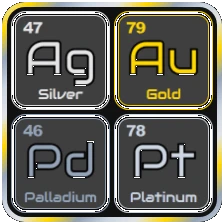
Our LIVE 1140-Position Matrix is a high-frequency, cross-commodity arbitrage engine. It bypasses broad macroeconomic speculation to focus entirely on order book mechanics, localized spreads, and real-time transactional efficiencies. Operating on a synchronized 10-second universal clock, this terminal allows you to cross-reference the microstructural relationships between Gold (Au), Silver (Ag), Palladium (Pd), and Platinum (Pt) with absolute precision. Since our system updates these 1,140 values every 10 seconds (8,640 times a day), our matrix is capable of providing NEARLY 10 MILLION UNIQUE DATA POINTS every single day!
Coupled with our QUAD-VIEW terminal, the ultimate macro-level dashboard (engineered specifically for second-monitor tracking), you'll always have the instantaneous pulse of the entire precious metals sector right at your fingertips. You can run as many windows as you want at once to fully customize your dashboard, and all instances are fully synchronized to the same universal clock. Whether looking at the app or website on your phone, or running 8 windows on three monitors at home, you'll always have a professional precious metals terminal available!
The Universal Synchronization Engine
Standard financial dashboards pull data asynchronously, causing cross-market lag that can severely skew your ratio and spread calculations when comparing independent metal feeds. The Stealth architecture forces a synchronized 10-second universal pulse, locking both Side A and Side B of the Matrix to the exact same millisecond and completely eliminating visual latency. While standard financial websites throttle their feeds with 60-second delays and a single price point (either BID, MID, or ASK), our architecture updates the live spot prices every 10 seconds and includes all three of those figures (along with the live SPREAD and daily OPEN* prices). Most generic commodity feeds truncate their data to the penny, but our engine calculates every position using underlying spot prices streamed with 4 DECIMAL PLACES OF PRECISION, feeding an advanced custom 8-digit precision slider. When you are running cross-commodity arbitrage on tight ratio bands, asynchronous lag and corporate rounding errors destroy your edge.
The 24/7 Weekend Advantage
Unlike corporate dashboards that freeze when traditional markets close, the Matrix provides 24/7 LIVE WEEKEND RATIO & SPREAD TRACKING across the entire precious metals sector with 10-second updates through the entire weekend! Most institutional sites go dark from 5:00 PM ET on Friday until Sunday at 6:00 PM ET, leaving you flying blind for 49 HOURS (over two full days). Precious metals don't stop moving just because traditional markets are closed. If global news breaks on a Saturday or supply chains shift over the weekend, the Matrix allows you to track real-time ratio movements and spread inversions across Gold, Silver, Platinum, and Palladium live, long before the standard markets open on Sunday evening.
The Dual-Pillar Architecture
The Matrix operates as a massive, dynamic calculator built on a dual-pillar system. You configure Side A (Left) and Side B (Right) independently, selecting both the specific metal and the exact order book metric (Open*, Bid, Mid, Ask, Spread). The central hub then processes the live relationship between those two pillars.
- The Math Toggles: The central switches allow you to view the data relationship as either a direct dollar-value Spread or a proportional Ratio. You can also toggle the underlying weight metric between Troy Ounces and Grams to match your physical inventory.
- The Swap Engine: Clicking the circular Swap icon in the center instantly reverses Side A and Side B. This is crucial for viewing reciprocal ratios (e.g., flipping the Gold-to-Silver ratio to see exactly what fraction of an ounce of gold a single ounce of silver buys).
- 8-Digit Precision: The engine is equipped with a custom precision formatter. Instead of relying on standard browser rounding, the slider at the bottom restricts the total visual footprint to your exact specifications (1 through 8 digits), ensuring high-frequency fractional data isn't lost in translation.
* Note: On days where there is no open price available, OPEN will default to the MID price of the metal.
The Math: Spread vs. Ratio
Depending on which mode the central hub is locked into, the engine fundamentally changes how it processes the data from the two pillars:
- Spread (A - B): Calculates the exact real-time dollar difference between the left and right side. If Side B is mathematically larger than Side A, the engine will automatically flag the inversion by turning the neon display Red and appending a negative sign (-$).
- Ratio (A ÷ B): Calculates proportional purchasing power. If Side A is Gold and Side B is Silver, the ratio tells you exactly how many ounces of Silver it takes to purchase a single ounce of Gold at that exact second.
The Physics of the Ratio
If you toggle the weight unit from Troy Ounces to Grams while in Ratio mode, you will notice that the neon numerical output does not change, and the unit label remains a dim grey (it lights up while in Spread mode). This is a mathematical absolute, not an error.
A ratio is a dimensionless number representing a proportion. To put it simply: if you have exactly 100 times more gold than silver, it doesn't matter if you weigh that pile in grams, ounces, or pounds; it is still exactly 100 times more. The physical weight unit cancels itself out. Dividing Gold grams by Silver grams yields the exact same proportional relationship as dividing Gold ounces by Silver ounces.
The 1,140-Position Breakdown
Configuring a 4x5 matrix against another 4x5 matrix, combined with two weight units, two math modes, and eight varying precision levels, initially looks like it would yield 12,800 possible visual states. However, when we take into account redundant data and mathematical dead-ends, we end up with a cardinality of 1,140 unique positions. Here is exactly how we arrive at the core positions:
- The Base Grid: 4 Metals × 5 Modes (Open, Bid, Mid, Ask, Spread) = 20 unique data states per side.
- The Cross-Reference: Side A (20) × Side B (20) = 400 total possible combinations.
- The Culling: We subtract the 20 identical 1:1 pairings (e.g., comparing Silver Mid to Silver Mid, which will always equal $0 or 1.0). This leaves exactly 380 actionable cross-pairs.
- The Spreads: Because Spread mode calculates a physical dollar value tied to mass, those 380 pairs are calculated for both weights (Troy Ounces and Grams) = 760 unique Spreads.
- The Ratios: Because Ratio mode calculates a dimensionless proportion, the weight unit is mathematically irrelevant and therefore only calculated once = 380 unique Ratios.
The Total Engine: 760 Spreads + 380 Ratios = 1,140 unique mathematical positions processed every 10 seconds.
Historical Context & Macro Arbitrage
Physical metal stackers and sophisticated traders use these live matrix positions to execute "ratio trading"—swapping physical metals to maximize their total ounce counts based on historical extremes.
- The Gold-to-Silver Ratio (GSR): The most tracked metric in precious metals. In ancient times, the ratio was fixed at around 15:1. In the modern era, it typically fluctuates between 50:1 and 90:1. When the ratio is high (e.g., 90:1), Silver is historically undervalued compared to Gold, prompting stackers to trade Gold for Silver. When the ratio compresses, they trade the Silver back for a heavier net position in Gold.
- The Platinum-to-Gold Ratio: For decades, Platinum was the "rich man's gold," trading at a steep premium to Gold (often above 1.5:1). Today, it trades at a massive historical discount to Gold. Stacking Platinum while this specific ratio remains inverted is a major modern arbitrage strategy.
- The Platinum / Palladium Anomaly: Historically, Platinum traded at a massive premium to Palladium (often 3:1 or 4:1). In the 2010s, the automotive industry shifted catalytic converter production to the cheaper Palladium, causing a massive industrial supply shock. The ratio violently inverted, making Palladium twice as valuable as Platinum. Trading these industrial spreads allows investors to capitalize on cyclical manufacturing shifts.